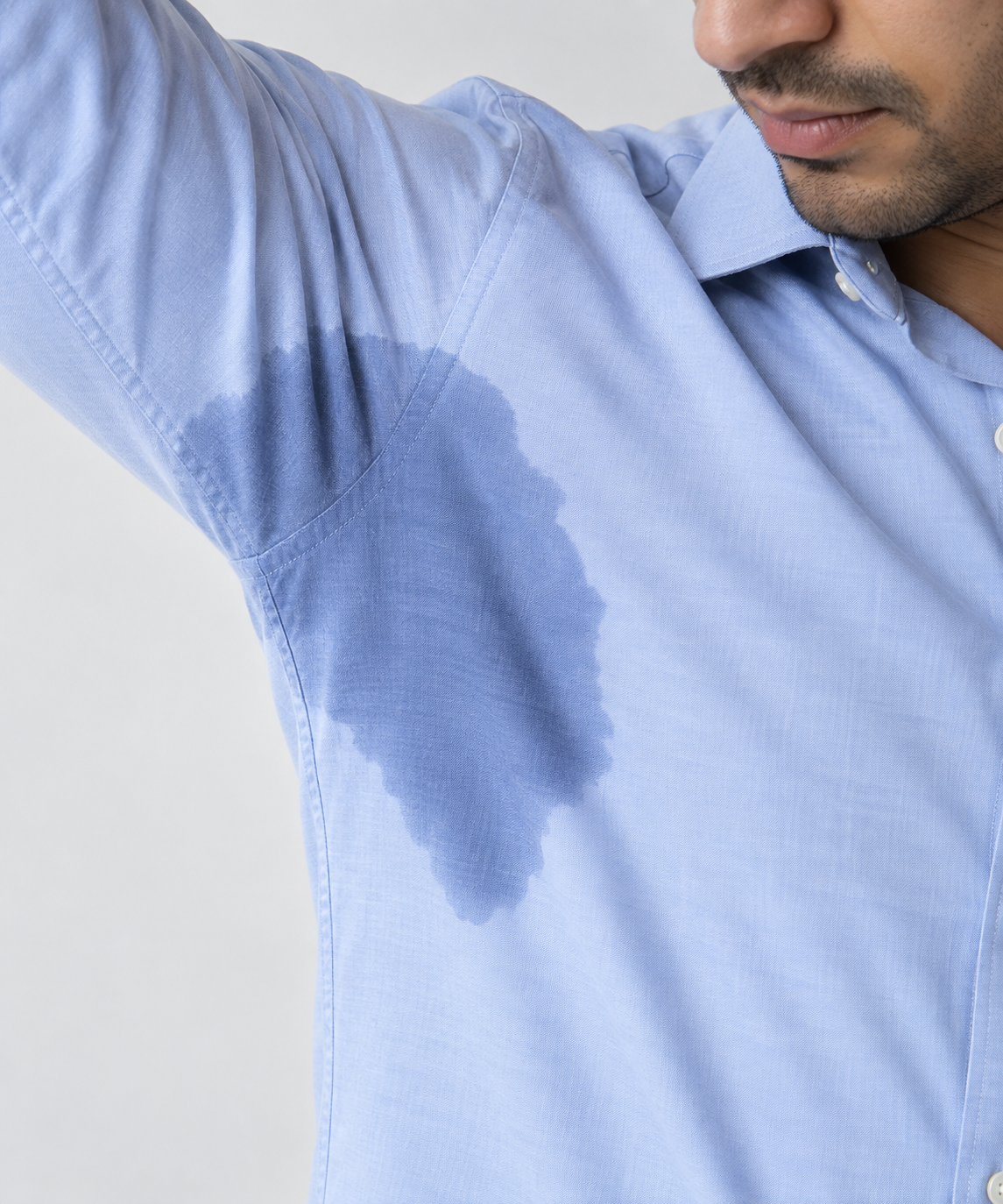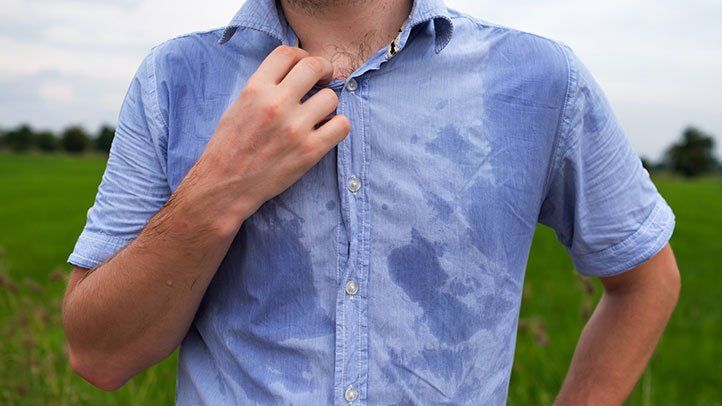
Moist palms during a handshake, damp patches appearing through your shirt before you've even reached the office, or feet that stay so sweaty that your shoes become uncomfortable.
If this sounds familiar, you're not alone.
Everyone sweats. It's a normal way for the body to regulate temperature. But for people with hyperhidrosis, sweating can be excessive enough to interfere with everyday activities, clothing choices, work, and social situations.
Hyperhidrosis affects an estimated 3-5% of the population, according to the International Hyperhidrosis Society. It can affect areas such as the underarms, hands, feet, face, or other parts of the body, depending on the type and individual.
The important distinction is that excessive sweating isn't simply a matter of needing to “sweat less.” When sweating is significantly affecting your daily life, there are ways to manage it - from practical clothing choices and lifestyle adjustments to clinical treatments.
This guide explains what hyperhidrosis is, how to recognize it, what can trigger excessive sweating, and the options available for managing it.
Quick Answer:
**Hyperhidrosis is excessive sweating that goes beyond what your body needs for normal temperature regulation.
Unlike ordinary sweating caused by heat, exercise, or physical activity, hyperhidrosis can cause significant sweating even when the environment isn't particularly hot or when you're not physically active.
It commonly affects the underarms, hands, feet, and face, although other areas can also be involved.
If sweating is frequent, difficult to control, or interfering with everyday activities, it's worth discussing it with a healthcare professional rather than assuming you simply “sweat a lot.”
What Is Hyperhidrosis?
Clinically, hyperhidrosis refers to excessive sweating that is disproportionate to the body's need to cool itself.
Normal sweating is part of thermoregulation. Your body increases sweat production when you're hot, exercising, or experiencing certain emotional responses.
With hyperhidrosis, sweating can happen more frequently or intensely than expected.
For some people, the problem is mainly concentrated in specific areas such as the:
- Underarms
- Palms
- Soles of the feet
- Face or scalp
For others, sweating can affect larger areas of the body.
The Two Main Types of Hyperhidrosis
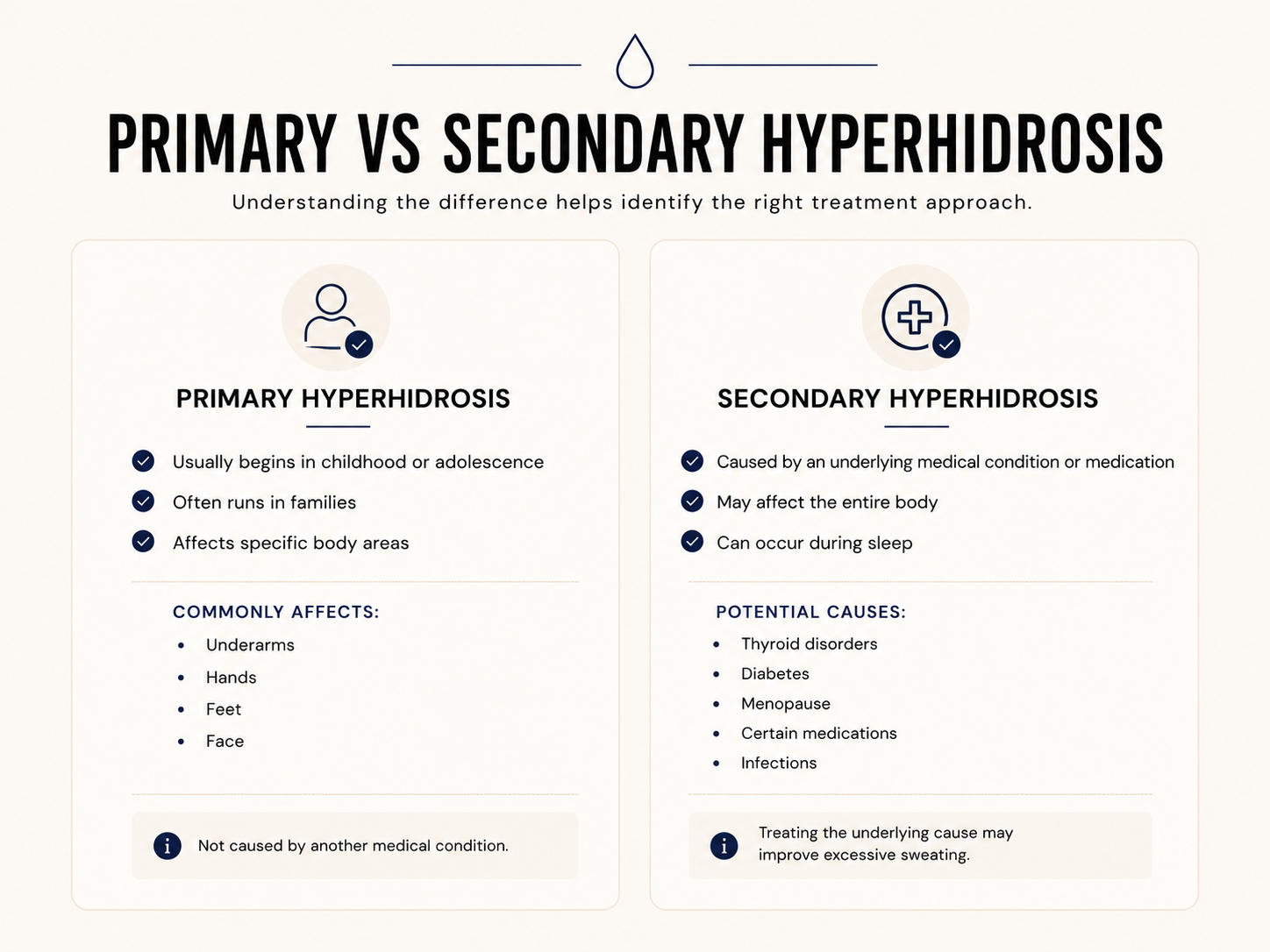
Hyperhidrosis is generally divided into primary and secondary hyperhidrosis.
Primary Hyperhidrosis
Primary hyperhidrosis occurs without another underlying medical condition being responsible for the excessive sweating.
It often affects specific areas of the body, such as both hands, both feet, or both underarms, and may begin earlier in life.
Secondary Hyperhidrosis
Secondary hyperhidrosis occurs when excessive sweating is associated with another condition, medication, or underlying cause.
Unlike primary hyperhidrosis, it may involve larger areas of the body and can sometimes occur during sleep.
Because secondary sweating can have different causes, new or unexplained excessive sweating should be discussed with a healthcare professional.
Recognizing the Signs: Is It More Than Just Sweat?
Everyone sweats.
The question is whether the amount of sweating is becoming excessive enough to interfere with your everyday life.
Some common signs include:
- Sweating heavily even when the environment is cool
- Clothing becoming noticeably damp or soaked without significant physical activity
- Excessive sweating affecting both hands, both feet, or both underarms
- Difficulty gripping objects because of sweaty palms
- Skin irritation caused by persistent moisture
- Frequently changing clothes because of sweating
- Avoiding certain colors or clothing because sweat marks are visible
- Feeling anxious or self-conscious about sweating
- Avoiding handshakes, social situations, or activities because of sweating
One symptom on its own doesn't necessarily mean you have hyperhidrosis.
But if excessive sweating is regularly interfering with work, social situations, clothing choices, or everyday activities, it may be worth speaking with a healthcare professional.
How Hyperhidrosis Can Affect Daily Life
The physical side of excessive sweating is only part of the problem.
For many people, the bigger frustration is having to think about sweat throughout the day.
You may find yourself:
- Checking your underarms before meetings
- Avoiding certain shirt colors
- Carrying an extra shirt
- Keeping tissues or towels nearby
- Avoiding handshakes
- Changing footwear frequently
- Worrying about sweat marks during presentations
- Planning your day around situations where sweating might become noticeable
This can make something as simple as commuting to work or attending a meeting feel unnecessarily stressful.
And importantly, the impact isn't limited to appearance.
Persistent moisture can also contribute to skin irritation and discomfort, particularly in areas where sweat remains trapped against the skin.
What Can Trigger Excessive Sweating?
Triggers vary from person to person.
Some commonly reported factors include:
- Hot or humid weather
- Physical activity
- Stress and anxiety
- Caffeine
- Alcohol
- Spicy foods
- Certain medications
For someone with hyperhidrosis, a trigger doesn't necessarily cause the condition itself. Instead, it may increase sweating that is already excessive.
Keeping track of when your sweating becomes worse can help you identify personal patterns.
For example, you might notice that your underarm sweating becomes particularly noticeable during presentations, while your palms sweat more during stressful conversations.
Understanding your own triggers can make management more practical.
How to Manage Hyperhidrosis
There isn't one solution that works for everyone.
Management depends on where you sweat, how severe the sweating is, what is causing it, and how much it affects your daily life.
Some people begin with practical changes and topical products, while others may need medical treatment.
1. Practical Clothing and Lifestyle Changes
Clothing won't treat hyperhidrosis itself, but the right clothing can help manage one of its most frustrating consequences: visible sweat and moisture on your clothes.
Choose Breathable Clothing
Look for clothing that allows airflow and feels comfortable in warm or humid conditions.
The right fabric depends on where you sweat and what you're doing. Cotton, linen, and certain performance fabrics can each have advantages depending on the situation.
However, remember that breathability and sweat visibility are not the same thing.
A breathable shirt can still show underarm sweat marks.
Consider Your Base Layer
If visible underarm sweat is one of your main concerns, the layer closest to your skin deserves attention.
A regular undershirt can provide a buffer between your skin and outer shirt, but a sweat-management undershirt is designed specifically around managing moisture before it becomes visible on the outer garment.
That's the specific gap YUGHO focuses on.
YUGHO's Sweatproof Undershirt uses a targeted underarm protection zone designed to help reduce moisture transfer to the outer shirt.
It isn't about changing how much your body naturally sweats. It's about managing what happens to that moisture once you sweat, particularly when visible underarm marks are the problem.
YUGHO Sweatproof Undershirt
Identify Your Personal Triggers
If certain foods, drinks, situations, or environmental conditions consistently make your sweating worse, tracking those patterns may help you manage them.
You don't necessarily need to eliminate everything that can trigger sweating. The goal is to understand what affects your sweating and make practical adjustments where possible.
2. Clinical-Strength Antiperspirants
Antiperspirants are different from deodorants.
While deodorants primarily address body odor, antiperspirants are designed to reduce sweat production at the treated area.
Healthcare professionals may recommend clinical-strength or prescription antiperspirants for people experiencing excessive sweating.
These products commonly use aluminum-based active ingredients that temporarily reduce sweat reaching the skin's surface.
If over-the-counter options aren't working well enough, a healthcare professional can advise whether a prescription-strength option is appropriate.
3. Prescription Treatments and Medical Options
When practical measures and topical treatments aren't enough, there are additional treatment options.
Oral Medications
Certain prescription medications can reduce sweating by affecting the nerve signals involved in sweat production.
However, these medications can have side effects and aren't suitable for everyone. They should be used under medical supervision.
Iontophoresis
Iontophoresis is commonly used for excessive sweating of the hands and feet.
During treatment, the affected areas are placed in water while a mild electrical current passes through it. Repeated sessions may help reduce sweating for some people.
Botox Injections
Botulinum toxin injections can temporarily block the nerve signals that stimulate sweat glands.
They are commonly used for areas such as the underarms and can reduce sweating for several months before the effect wears off.
A dermatologist or other qualified healthcare professional can determine whether this treatment is appropriate.
When Should You See a Doctor?
Not every person who sweats heavily has hyperhidrosis.
But excessive sweating deserves medical attention when it is:
- Interfering with work or daily activities
- Affecting your social life
- Happening without an obvious reason
- New or significantly different from your usual sweating
- Occurring during sleep
- Accompanied by other unexplained symptoms
A healthcare professional can help determine whether the sweating is primary hyperhidrosis, secondary hyperhidrosis, or another issue that needs investigation.
Managing Hyperhidrosis Is About More Than Stopping Sweat
Hyperhidrosis can affect much more than how much you sweat.
It can influence what you wear, how you commute, how comfortable you feel in meetings, and whether you're constantly thinking about what other people might notice.
The right approach depends on the person.
For some, practical changes such as breathable clothing, identifying triggers, and choosing the right antiperspirant may be enough. Others may benefit from treatments such as iontophoresis, prescription medication, or injections under medical supervision.
And when visible underarm sweat marks are the specific problem, clothing can play a practical role too.
That's where YUGHO fits in.
YUGHO's Sweatproof Undershirt is designed to help reduce visible underarm sweat marks by managing moisture at the underarm area before it reaches your outer shirt.
It doesn't need to be the solution to hyperhidrosis itself to be useful. It addresses a specific everyday consequence of excessive sweating having your sweat become visible on the clothes you're wearing.
If excessive sweating is affecting your daily life, the first step is understanding what's happening and finding the right combination of solutions for you.
Frequently Asked Questions About Hyperhidrosis
Can hyperhidrosis be cured?
There isn't one universal cure for primary hyperhidrosis, but it can often be managed with treatments and practical strategies. Secondary hyperhidrosis may improve when its underlying cause is identified and treated.
Do sweatproof undershirts work for hyperhidrosis?
A sweatproof undershirt can help manage visible underarm sweat marks, but it doesn't treat hyperhidrosis or reduce the body's underlying sweat production. YUGHO is designed specifically to help reduce moisture transfer from the underarm area to outer clothing.
What triggers hyperhidrosis?
Triggers vary between individuals. Heat, humidity, physical activity, stress, caffeine, alcohol, spicy foods, and certain medications can increase sweating in some people.
Is hyperhidrosis caused by poor hygiene?
No. Hyperhidrosis is not caused by poor hygiene. It is associated with excessive activity of the sweat glands and, depending on the type, may occur without another underlying condition.
When should I see a doctor about excessive sweating?
Consider speaking with a healthcare professional if sweating is interfering with your work, social life, or daily activities, if it starts suddenly, occurs during sleep, or is accompanied by other unexplained symptoms.
Does hyperhidrosis only affect the underarms?
No. Hyperhidrosis can affect the underarms, palms, soles of the feet, face, scalp, or other areas depending on the individual and the type of hyperhidrosis.
What Our Buyers Are Saying
★★★★★
“I was suffering from underarms sweat and it makes me feel embarrassing to see sweat marks in my tshirt, then I came to know about YUGHO sweatproof tshirt and I ordered it straight away as I was looking for such products which can solve my this problem… there is no stain mark in my shirts… If someone sufferings from sweat and worried about sweat marks in their shirt, without a second thought just order YUGHO.”
- Nikhil Anand
★★★★★
“Justified the main motive.! Sweat didn't appear outside the underarm patch.! The product is light weight to wear.! Used it for almost 6-7 hours under sweat condition.! Zero visibility of sweat in the underarm. It completely blended with my shirt inside, just like every inner. Extremely great to cover the formals.”
- Naveen Anandan
About the Author
Hi, I'm Pooja, Founder of YUGHO
With a background in apparel and textile development, I spend my time studying how fabrics, garment construction, and layering systems affect everyday comfort. Through YUGHO, the focus is on creating sweat-management essentials that help people feel more comfortable and confident during real life situations such as commuting, work, presentations, and daily wear. YUGHO was built on a simple belief clothing should solve everyday problems and add genuine value to the people who wear it.
Medical Disclaimer: This article is for educational purposes only and should not be considered medical advice. If excessive or persistent sweating affects your daily life, consult a qualified healthcare professional. Our content is researched using trusted medical sources and evidence-based information.